
Our corporate responsibilities
Environment
Our vision is to continue to serve our region with the cleanest, greenest modes of transport, helping people make green choices while supporting our local communities.
We already provide the most sustainable mode of public transport in Tyne and Wear, and our Environment and Sustainability Strategy sets out a plan to build on this through constant accountability, assessment, and improvement.
The strategy helps us embed sustainability into our culture through policy and project proposals. It focuses on reducing environmental impacts across four main themes: Greenhouse Gas Emissions, Waste Management, Improving Biodiversity, and Climate Resilience.
We’re committed to protecting and enhancing the natural environment by minimising the environmental impact of our operations, aiming for ambitious reductions in greenhouse gas emissions while building a more resilient, reliable public transport network.
Our strategic plan includes:
Benchmarking
- Defining our baseline: emissions, waste volumes, and energy consumption.
Monitoring
- Committing to a minimum annual reduction of 8% GHG emissions.
- Producing annual internal and public reports on our environmental performance.
Evaluation and Improvement
- Creating a centralised fund to provide investment for energy saving projects.
- Prioritising decarbonisation on every bus route we operate.
- Establishing specifications and locations for electric vehicle infrastructure.
- Improving station architecture to support sustainability.
- Creating a Biodiversity Action Plan to enhance habitats and a Climate Adaptation Report to tackle key infrastructure vulnerabilities associated with climate change.
- Aiming for Biodiversity Net Gain on some major projects.
Our environmental initiatives
Our Environmental Management System (EMS) aligns with our Environment and Sustainability Strategy targets and is certified to the international ISO 14001:2015 standard. This helps us measure and manage our environmental risks.
Our ferry services contribute 3.2% of our direct CO2 emissions. To help reduce this we’ve installed rev limiters and implemented eco-driving training, as well as working with partners including Newcastle University to carry out studies into how we can improve the ferries’ environmental performance. These have explored using alternatives to diesel, including batteries or hydrogen, and looking at mooring solutions to reduce the time the engines are running.
We conduct baseline ecological surveys to assess and establish the potential for increasing the habitats and species within the railway environment, with further targeted surveys if we confirm or suspect the presence of protected species. These help us classify the types of habitats we have (UK BAP Priority Habitats) and understand how to better maintain these, improving the quality and quantity of habitats available. We carry out biodiversity indexing on a periodic basis to establish the impacts of schemes.
We implemented a rewilding programme at our Howdon Depot to increase its green footprint, scattering wildflower seeds to encourage diverse plant growth. We have also created an area within the depot boundaries to help protect the rare Dingy Skipper moths which inhabit the site. The project was shortlisted for an environmental award by the Chartered Institute of Ecology and Environmental Management.
We’re committed to reducing, reusing and recycling our waste and have several initiatives and policies in place. For any new waste management contract, we ask prospective bidders to demonstrate a commitment to operate within a Zero Waste to Landfill policy, and report on this throughout their tenure. We have a target to reduce the amount of waste we generate as a business and actively incentivise our contractors and colleagues to recycle and reuse. We also donate equipment to local charities for reuse. At the end of 2022/23 our overall recovery/recycling rate was 74.84%, with the remainder being consigned as Refuse Derived Fuel (so zero waste consigned to landfill).
We’re committed to saving energy by encouraging and supporting behavioural change and through modifications to our infrastructure, buildings and systems. We encourage our colleagues to reduce energy use wherever they can. Our energy-efficiency efforts include: • Installing LED lighting in stations and on the Shields Ferry • Installing photovoltaic systems on our bus stops, with dimmed lighting when not in use • Using multi-functional-devices (MFDs) across the whole business and, when printing is necessary, printing double-sided. This has reduced our energy use and also that of other consumables such as ink and paper. • Saving £110,000 per year in energy and 630 tonnes of CO2 by implementing recommendations from a subway climatology study • Installing a Building Management System and lighting at Infrastructure Gosforth, our rail headquarters • Continually monitoring energy consumption
One of our key objectives is to encourage our colleagues and visitors to choose more environmentally friendly transport than the car. We’re doing this through a combination of: • Leading by example. • Promoting public transport, walking and cycling in a positive way. • Improving on-site facilities and security. • Providing up-to-date travel and service information. • Raising awareness of this travel plan throughout our organisation. • Providing our employees, and their partners and dependents, with free public transport locally. • In return, we’re all benefiting from a sense of ownership, improved health and fitness, and reduced air pollution and carbon emissions.
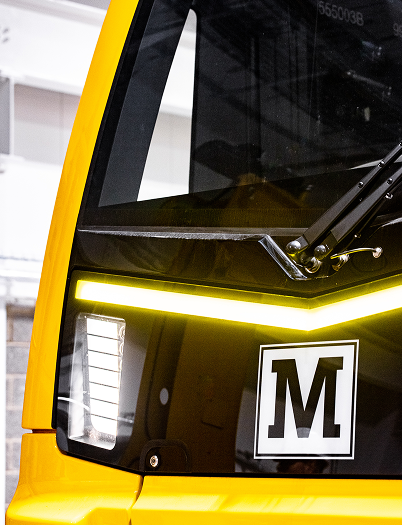
Leaving the car at home and using public transport is one of the easiest ways to do your bit for the environment. According to the Energy Saving Trust nearly half of us use a car for short journeys that could otherwise be completed in a more sustainable way. And by cutting down on air pollution, using public transport has health benefits too. Metro is a very sustainable way to travel—only walking and cycling have a lower carbon footprint than our new fleet trains.
We manage about 50km of lineside wildlife habitats alongside the Metro tracks. This mixture of embankments, cuttings, former sidings and other non-operational land represents distinct wildlife corridors. Where we can, we also work with communities to make sure land not currently required, and which is safe to access without interfering with the railway, is put to good use, including The Station Master's Garden in Whitley Bay, a community garden and urban paradise.
Social responsibility
It’s very important to us to do business ethically, promote the health, safety, wellbeing and development of our people, and have a positive impact on our local communities and wider society. We work with customers, colleagues, suppliers, partners, communities and other stakeholders to always uphold these core business principles:
- We recognise that our social, economic and environmental responsibilities to our stakeholders are integral to our business. We demonstrate these responsibilities through our actions and in company policies and strategies.
- We take all stakeholder feedback seriously.
- We’re open and honest in communicating our strategies, targets, performance and governance to stakeholders, as part of our ongoing commitment to sustainable development.
- We’re committed to full legal compliance in everything we do.
- We aim to provide a safe, fulfilling and rewarding career for all our employees.
- We actively assess and manage the environmental impacts of our operations.
- We’ll continue to elevate our standing as a responsible business in the community.
- We strive to support local, national and international causes where we have a business presence.
- We’ll benchmark and evaluate what we do to monitor outputs against our targets and objectives.
- We’ll operate in a way that safeguards against unethical or unfair business practices.